
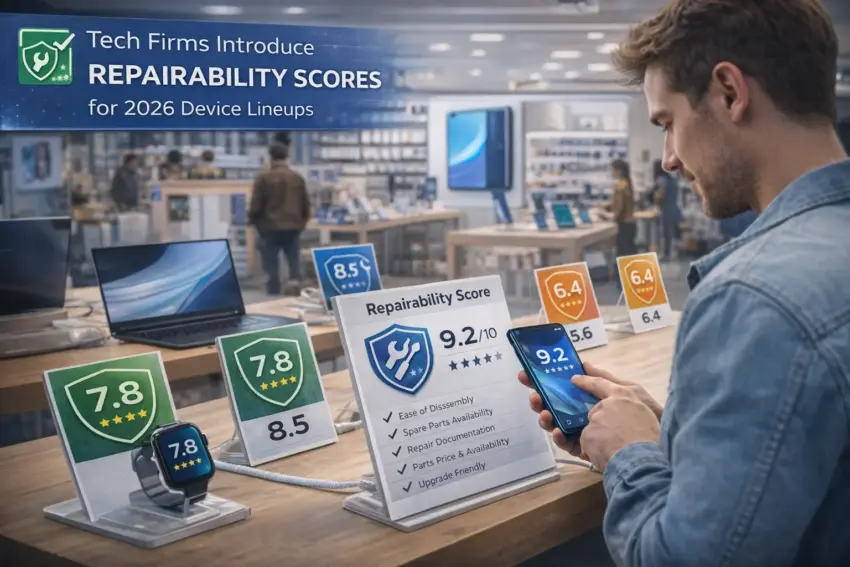
Tech firms are adding clearer “repairability scores” to their 2026 device lineups as pressure grows from regulators, retailers, and consumers to make durability and repair options easier to compare at the point of sale. The shift builds on the EU’s new labeling regime for smartphones and tablets, which requires an energy label that also includes a repairability score alongside battery and durability information.
Manufacturers and platforms say the goal is to reduce confusion about what “repairable” actually means. In addition to the EU-mandated label, some brands are testing supplementary in-app details, QR-linked pages, and marketing-ready scoring summaries to highlight spare-part availability, expected software support, and how quickly common repairs can be completed.
Why repairability scores are showing up now
The EU’s approach is moving repairability from niche advocacy into a standardized consumer signal. From June 20, 2025, smartphones and tablets placed on the EU market must display an energy label that includes a repairability score and other durability-related information, while ecodesign rules introduce requirements on disassembly, spare parts availability, and minimum battery performance.
The Commission’s Joint Research Centre has also positioned the score as a practical tool to help consumers choose more repairable electronics, and to support a stronger repair ecosystem.
What the EU repairability score is intended to capture
The EU label is designed to present repairability in a simple rating scale, so shoppers can compare devices quickly. The accompanying ecodesign requirements cover topics that directly affect real-world repair and longevity, including access to critical spare parts, disassembly and repair rules, and software/firmware access for professional repairers where needed.
How companies are extending the idea for 2026 models
For 2026 lineups, companies are increasingly treating repairability as a product attribute that can be communicated in multiple layers:
- On-box and retail display callouts that mirror the EU label and point to detailed repair documentation.
- QR-linked “repair pages” summarizing spare-part availability, estimated repair steps, and service network options.
- Warranty and service transparency explaining what is covered, typical turnaround times, and parts ordering windows.
- Software support commitments framed as part of device longevity (updates, security patches, and support timelines).
Industry watchers expect the biggest competitive differences to show up in how easy it is to replace high-failure parts (battery, display, charging port) and how predictable parts access is over time, especially as EU rules require spare parts availability and faster delivery windows for key components.
Independent scoring is influencing expectations
Alongside official labels, independent evaluators continue to shape public perception. Repair-focused organizations such as iFixit publish teardown-based repairability scores for smartphones, which many consumers use as a cross-check against manufacturer claims. As repairability becomes a mainstream buying factor, brands are increasingly incentivized to align product design with the criteria that show up in both regulatory labels and third-party assessments.
“Repairability is becoming a front-of-store metric, not a hidden technical detail—especially in markets where labels and ecodesign rules force consistent disclosure.”
What to watch in 2026
As more devices ship under the EU’s labeling and durability framework, attention is likely to shift from whether a score exists to whether it matches user experience. Consumer groups are expected to focus on parts pricing, repair turnaround times, and whether software and diagnostic access is genuinely practical for independent repair. At the same time, manufacturers will be watching how strongly repairability scores influence sales in retail comparisons—especially as more buyers treat longevity as a value-for-money factor, not just an environmental one.