
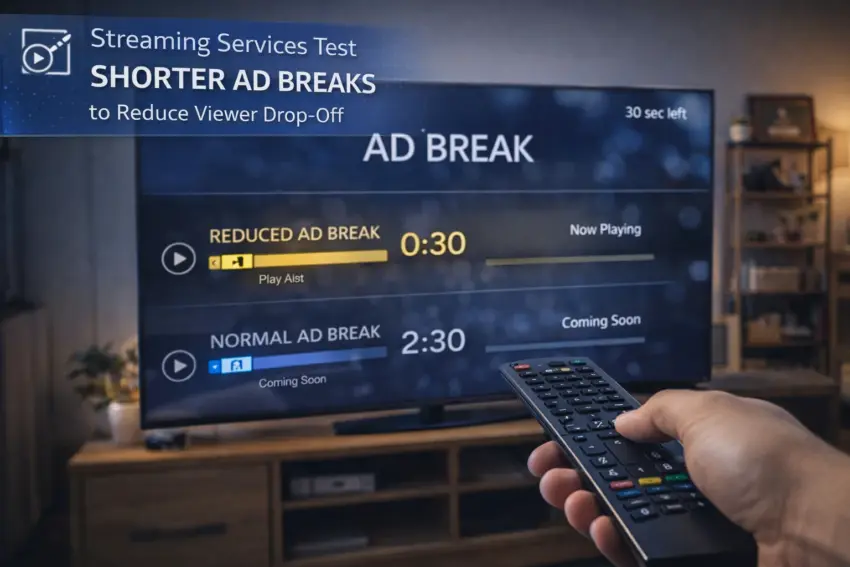
Streaming services are testing shorter ad breaks in an effort to reduce viewer drop-off and make ad-supported tiers feel less disruptive. The experiments focus on trimming total ad time per interruption, reducing the number of ads shown back-to-back, and improving how breaks are placed—especially during the first minutes of an episode, when audiences are most likely to abandon playback.
What “shorter ad breaks” look like
In streaming, an ad break (often called an “ad pod”) is a sequence of ads inserted before or during a program. Shorter pods typically mean fewer ads per break and fewer total seconds, with a stronger push to keep interruptions predictable.
- Reduced pod length (for example, 15–45 seconds instead of 60–90 seconds).
- Fewer ads per break to reduce “clutter” and repetition.
- Smarter placement aligned with scene transitions or episode boundaries.
- Lower early-session load to avoid driving viewers away immediately.
- Single-sponsor pods where one brand occupies a short break.
Why platforms are making changes now
Ad-supported tiers have become a key growth lever as subscription fatigue rises and price-sensitive viewers look for cheaper options. But streaming audiences have low tolerance for long, TV-style breaks. If viewers exit during ads, platforms lose impressions and weaken the value of their inventory—while also increasing the risk that users switch to a competitor.
Services also have more precise data than linear TV: they can measure exactly when drop-off happens and correlate it with break length, placement, frequency, and ad repetition. That makes ad pacing a controllable product feature rather than a fixed broadcast constraint.
The business case: fewer seconds can still mean more impressions
Shorter breaks reduce immediate annoyance, which can keep viewers watching longer. Platforms argue that higher completion rates and longer sessions can offset fewer ads per break by delivering more total viewing time and more successful ad views over the full session.
- Higher ad completion if viewers stop abandoning breaks.
- Longer sessions that create more overall inventory across a viewing period.
- Better pricing for “lighter ad load” placements that feel premium.
- Improved brand impact when ads are seen with less clutter.
What viewers may notice
If the tests expand, viewers may see interruptions that feel shorter and more predictable, with fewer “back-to-back” ads and less repetition. Some services may also shift to fewer breaks with slightly longer intervals between them, rather than frequent short interruptions.
- Shorter mid-roll breaks that end before viewers reach for the remote.
- Less repeated ads within a single episode or session.
- More sponsor formats like “presented by” bumpers instead of long pods.
- Clearer expectations about ad timing through consistent placement rules.
Risks: shorter breaks can backfire if frequency increases
Shorter pods do not automatically improve the experience. If platforms compensate by increasing how often breaks appear, viewers may still feel interrupted. Repetition is another pain point: even a short break can be frustrating if it shows the same spot repeatedly. Many experiments therefore combine shorter pods with better pacing and frequency caps.
What happens next
Expect more A/B testing across markets and content types, since sports, films, and episodic series behave differently. Platforms will also watch advertiser reaction: lighter ad loads can be attractive if measurement improves, but they require pricing models that reward quality and completion rather than raw volume.
Bottom line
Shorter ad breaks are becoming a key tactic in the competition for ad-supported streaming viewers. The goal is simple: reduce the moment when people leave. Whether the strategy succeeds will depend on pacing, placement, and repetition control—turning ad load into a user-experience decision as much as a revenue decision.