
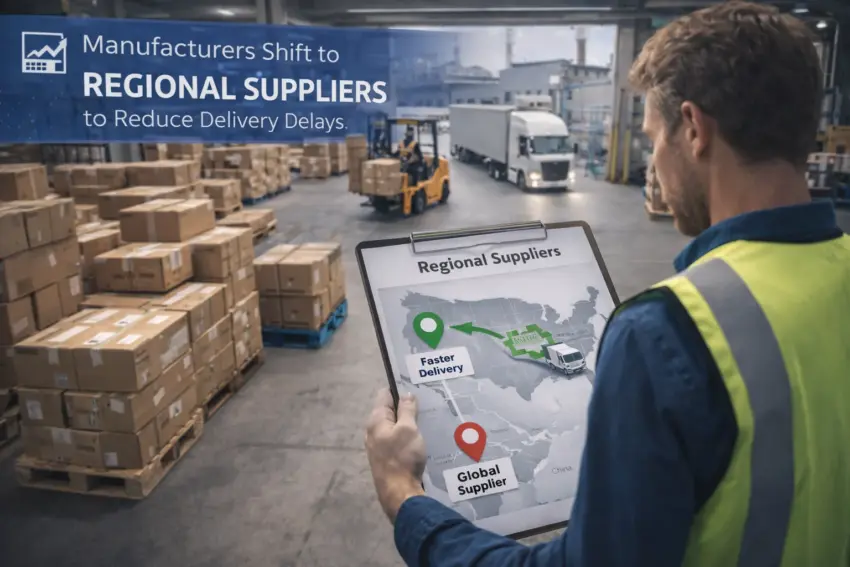
Manufacturers are shifting more sourcing to regional suppliers in an effort to reduce delivery delays and make supply chains more predictable. After years of disruption—from shipping bottlenecks to sudden component shortages—procurement teams are increasingly prioritizing reliability and shorter lead times alongside price, especially for parts that can halt production if deliveries slip.
Why regional sourcing is gaining momentum
Global supply chains remain efficient for many product categories, but they can be fragile when transport capacity tightens or when geopolitical and regulatory conditions change. Regional suppliers can reduce exposure to long transit times and port congestion, while making it easier to coordinate quality checks and production changes.
- Shorter lead times with fewer border crossings and less ocean freight dependence.
- Lower disruption risk from port backlogs, container shortages, and route changes.
- Faster quality resolution through proximity and easier site visits.
- Better forecasting when delivery cycles are more consistent.
- Compliance simplicity when suppliers operate under similar regulatory frameworks.
Which industries are shifting first
The strongest moves are often seen in sectors where delays can stop production lines and where parts are relatively standard. Automotive suppliers, industrial manufacturing, consumer electronics assemblers, and packaging-heavy industries are among the groups most actively reassessing supplier footprints.
- Automotive and mobility for components with strict just-in-time production needs.
- Industrial equipment where spare parts availability affects service commitments.
- Packaging and materials tied to high-volume daily production.
- Electronics sub-assemblies where shipping delays can break launch schedules.
What it means for Germany’s manufacturing base
In Germany, where manufacturing clusters depend on tight coordination across suppliers, the regionalization trend can strengthen local networks—particularly in automotive corridors and industrial hubs. Companies are also looking more closely at suppliers within the EU, where transport routes are shorter and regulatory alignment reduces friction in documentation and standards.
However, reshoring or nearshoring is not uniform. Many firms are adopting a “dual sourcing” strategy, keeping global suppliers for cost advantages while adding regional partners for resilience and emergency capacity.
Trade-offs: cost and capacity constraints
Regional suppliers can be more expensive, particularly for labor-intensive components. Capacity is another constraint: local production may not scale quickly enough to replace global volumes. Manufacturers also face qualification cycles, where new suppliers must meet quality standards, pass audits, and prove consistent output before being trusted for critical parts.
- Higher unit costs compared with some overseas options.
- Limited capacity if regional suppliers are already operating near full load.
- Supplier qualification time for audits, testing, and contract negotiation.
- Tooling and redesign needs if parts must be adapted for new production lines.
- Dependency shift where concentration moves from ports to regional bottlenecks.
How companies are implementing the shift
Rather than moving entire supply chains at once, many firms are prioritizing “risk parts” first—items with long lead times, single-source exposure, or high disruption impact. They also use inventory buffers more strategically, keeping safety stock for components where delays would be most costly.
- Mapping critical components and identifying single points of failure.
- Adding second suppliers within the region for resilience.
- Localizing final assembly while keeping some upstream sourcing global.
- Strengthening forecasting with shared data and supplier collaboration.
- Building safety stock for high-risk parts during transition periods.
Bottom line
The shift toward regional suppliers is a response to a core manufacturing reality: delays cost more than many procurement spreadsheets capture. By adding regional sourcing and dual-supplier strategies, manufacturers aim to stabilize production and reduce delivery volatility. The main constraints will be price, supplier capacity, and the time needed to qualify new partners—factors that will determine how quickly regionalization scales across industries.