
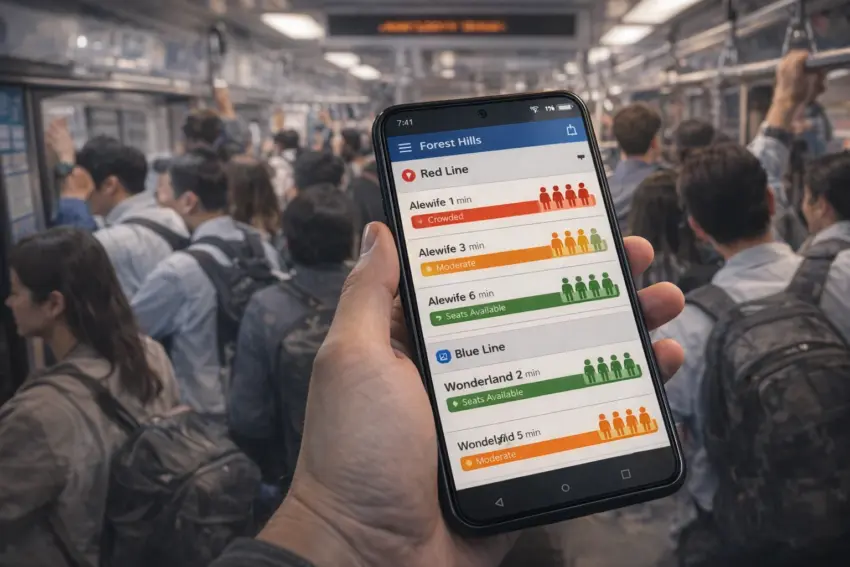
Public transit apps are adding real-time crowding indicators during peak hours, giving passengers clearer signals about how full buses, trams, and trains are before they arrive. The feature is designed to reduce platform congestion, improve comfort and accessibility, and help riders make quick decisions—such as taking the next service, choosing a different carriage, or adjusting departure times.
How crowding indicators work
Most crowding systems combine multiple data sources to estimate occupancy. Some rely on vehicle sensors and automated passenger counting, while others use ticketing events, historical patterns, or anonymized device signals. The app then translates the estimate into a simple scale—often “low,” “medium,” or “high”—or a color-coded level for each line and departure.
- Passenger counting sensors at doors to track boardings and exits.
- Vehicle load data from onboard systems where available.
- Historical demand models adjusted for day, time, and events.
- Real-time updates when disruptions change travel patterns.
- Carriage-level estimates on some rail services where data granularity allows it.
Why transit agencies are prioritizing the feature
Peak-hour crowding affects reliability and passenger satisfaction. When vehicles are overloaded, dwell times increase as boarding slows, causing knock-on delays across the network. Agencies argue that visibility can spread demand: if riders see a packed service approaching, some will choose the next departure or a less crowded route, smoothing peaks and improving overall punctuality.
Accessibility is another driver. For people with mobility needs, traveling with a stroller, or carrying luggage, knowing crowding levels in advance can help avoid situations where boarding becomes difficult or unsafe.
What riders in Germany may notice
In Germany, crowding indicators are increasingly appearing in regional transport apps and integrated mobility platforms. Riders may see occupancy information alongside real-time departure updates, platform changes, and disruption notices. Some apps also add recommendations, such as suggesting a less crowded segment of a train or an alternative line with similar travel time.
- Fullness labels for upcoming departures on key commuter lines.
- Peak-hour alerts when expected crowding exceeds a threshold.
- Carriage guidance indicating where space is more likely to be available.
- Alternative route suggestions optimized for comfort as well as travel time.
Limits: estimates are not perfect
Crowding indicators are probabilistic. Sudden surges—such as after a delay, a canceled service, or a stadium event—can overwhelm forecasts. Sensors can also miscount in complex boarding situations. That is why many agencies present crowding as a range rather than an exact number and update the estimate continuously as vehicles move through stops.
Privacy and data considerations
Transit agencies emphasize that crowding indicators can be delivered without identifying individuals. Systems based on door sensors or vehicle telemetry do not require personal data. Where operators use aggregated device signals or ticketing patterns, privacy expectations in the EU push toward anonymization, minimization, and strict retention policies. Clear communication about data sources is likely to be important for public trust.
What comes next
As more agencies deploy the feature, the next improvements are expected to focus on accuracy and granularity—moving from line-level estimates to carriage-level guidance and better predictions during disruptions. Some operators may also integrate crowding data into operational decisions, such as dispatching additional vehicles, adjusting stop dwell times, or improving station staffing during predictable peaks.
Bottom line
Real-time crowding indicators in transit apps are becoming a practical tool for managing peak-hour pressure. For riders, they offer more comfort and predictability. For agencies, they can help smooth demand and improve reliability—provided the data is accurate, updated quickly during disruptions, and implemented with privacy safeguards that match European expectations.