
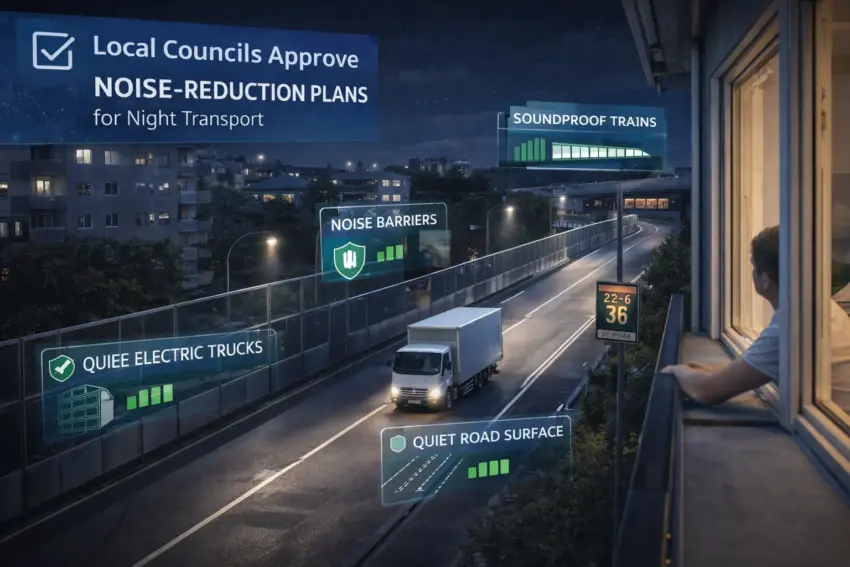
Local councils in several German municipalities are approving new noise-reduction plans aimed at night-time public transport, responding to persistent complaints from residents living near tram corridors, bus routes, rail lines, and late-night service streets. The measures are designed to reduce sleep disruption without cutting night mobility, which many cities consider essential for shift workers, hospitality staff, and safer travel options after evening events.
Rather than relying on a single rule, the plans typically combine infrastructure work, operating changes, and targeted enforcement. Councils say the objective is to address the loudest “hotspots” first—areas where braking noise, track vibration, idling engines, or high-speed passes create repeated night-time peaks.
What the plans usually include
While packages vary by city and transport network, many approved plans share common elements:
- Targeted night speed reductions on short sections to lower rolling noise and reduce harsh braking.
- Track and roadway maintenance such as rail grinding, improved bedding, and smoother asphalt on bus routes.
- Anti-idling rules at night stops and depots, supported by signage and driver guidance.
- Low-noise braking and wheel upgrades where fleets can be retrofitted or renewed.
- Noise barriers and façade protection near the most affected residential buildings.
- Operational changes including revised dispatching, smoother acceleration profiles, and quieter maintenance scheduling.
- Noise monitoring using sensors and structured complaint tracking to identify recurring peaks.
Some councils are also coordinating with freight operators and service companies to reduce late-night loading noise around stations and delivery points, shifting the loudest activities away from deep night hours where possible.
Why night transport has become a focal point
Many urban areas have expanded night services over the past decade, extending tram and bus hours on weekends, adding late rail connections, and increasing overnight maintenance activity. At the same time, housing density has grown near transport corridors, placing more homes close to tracks and busy routes where sound can peak. Councils argue that reducing conflict over night services helps protect broader mobility strategies, including efforts to shift travel from cars to public transport.
Public health experts often emphasize that night noise is not only an annoyance issue. Repeated sleep disruption can affect well-being, which is why administrations increasingly treat noise plans as a health and planning topic rather than a purely operational transport issue.
How cities measure whether it works
Municipal plans increasingly set measurable targets, using a combination of fixed sensors and periodic checks. Typical indicators include reductions in average night decibel levels, fewer extreme peak events, and a decline in complaint volumes after specific changes are introduced. Some councils require transport operators to publish progress updates, including maintenance timelines and the rollout status of quieter components.
“The aim is not to remove night mobility, but to reduce the disruptive peaks that wake people up—especially in dense neighborhoods.”
Concerns about service impacts
Transport operators caution that speed limits and operational constraints can affect punctuality and connection reliability, particularly on long corridors. Rider groups also warn against measures that could lead to reduced late services, arguing that the burden would fall most heavily on people who depend on night transport for work.
Councils say they are aiming for targeted interventions rather than blanket restrictions, prioritizing technical fixes and maintenance improvements that reduce noise without reducing service. Many measures are introduced as pilots first, with further expansion dependent on results.
Next steps and timelines
Most plans follow a phased timeline. Quick steps—such as anti-idling enforcement, signage, driver guidance, and limited speed changes—can be implemented relatively fast. Larger projects like barriers, resurfacing, and rail upgrades require procurement and engineering work, often over multiple budget cycles. Where responsibilities are shared, councils also need coordination with regional rail authorities and infrastructure owners.
If pilots show measurable improvement, local governments expect noise-reduction planning for night transport to become a standard part of route management—alongside safety, accessibility, and climate goals.