
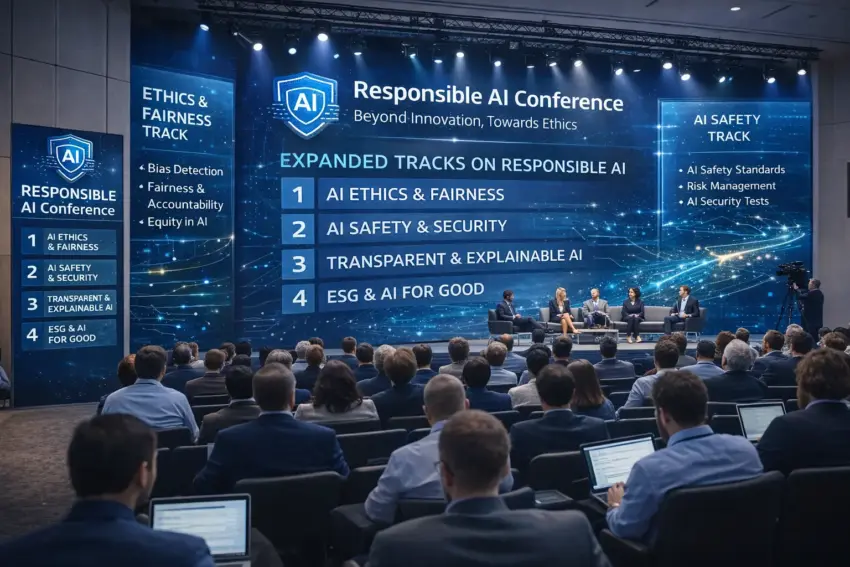
Conference organizers are expanding tracks focused on responsible AI, reflecting a shift in how companies and researchers evaluate new tools: performance alone is no longer enough. More events are adding dedicated sessions on safety testing, governance, transparency, and compliance—especially as AI systems move from pilot projects into high-impact uses in finance, healthcare, hiring, and public services.
What “responsible AI” tracks typically cover
Responsible AI programming usually sits alongside technical deep-dives, but with a different focus: how systems behave in real environments, what risks they introduce, and how organizations can manage those risks across the full lifecycle—from data collection to deployment and monitoring.
- Safety and robustness: red-teaming, stress tests, and failure-mode analysis.
- Bias and fairness: measurement methods, dataset audits, and mitigation strategies.
- Transparency: documentation, explainability approaches, and model cards for stakeholders.
- Privacy and data governance: minimization, retention policies, and secure processing.
- Security: prompt injection, data leakage, supply-chain risks, and access controls.
- Compliance: practical interpretations of EU and national requirements for AI systems.
Why organizers are expanding these sessions now
The demand is being driven by procurement and accountability. More buyers—especially enterprises and the public sector—now ask vendors to demonstrate controls: how models are tested, how incidents are handled, and how data is protected. Conference agendas are adapting as responsible AI becomes a cross-functional topic involving engineering, legal, risk, and product leadership.
Organizers also say the audience has widened. Responsible AI content is no longer only for policy specialists; product managers, security teams, and data leaders increasingly attend these sessions to translate principles into operational checklists.
What’s changing in conference formats
Instead of isolated panels, many events are building multi-level programming that includes hands-on workshops, case studies, and technical labs. The emphasis is on practical implementation—what works, what fails, and how teams measure risk reduction.
- Hands-on workshops for model evaluation, bias testing, and safety tooling.
- Incident response playbooks for AI-related failures and public communications.
- Governance templates for approvals, risk scoring, and documentation workflows.
- Live demos of guardrails, monitoring dashboards, and policy-as-code approaches.
- Cross-discipline panels that include security, legal, and product owners, not only researchers.
Why it matters for Germany and the EU
In Germany and across the EU, responsible AI is increasingly shaped by regulatory expectations and sector-specific rules. That environment pushes organizations toward stronger documentation, clearer accountability, and demonstrable risk controls—topics that naturally fit conference education tracks. For many companies, the challenge is not awareness but execution: turning abstract principles into deployable product requirements.
How attendees use these tracks
Professionals attending responsible AI sessions often look for concrete outputs they can take back to their teams—policies, checklists, and measurement frameworks. The most valued sessions tend to be those that share real deployment lessons, including trade-offs between usability and safety.
- Internal policy building: adapting governance templates to company processes.
- Vendor evaluation: learning what questions to ask AI providers and integrators.
- Security alignment: connecting AI risks to existing threat models and controls.
- Product design: embedding guardrails and user disclosures into feature planning.
Bottom line
The expansion of responsible AI tracks signals a maturing market: organizations want AI systems that are not only capable, but also safe, auditable, and defensible in real-world use. As conferences shift from hype-driven demos toward operational guidance, responsible AI content is becoming a core part of professional development for teams building and buying AI across Europe.