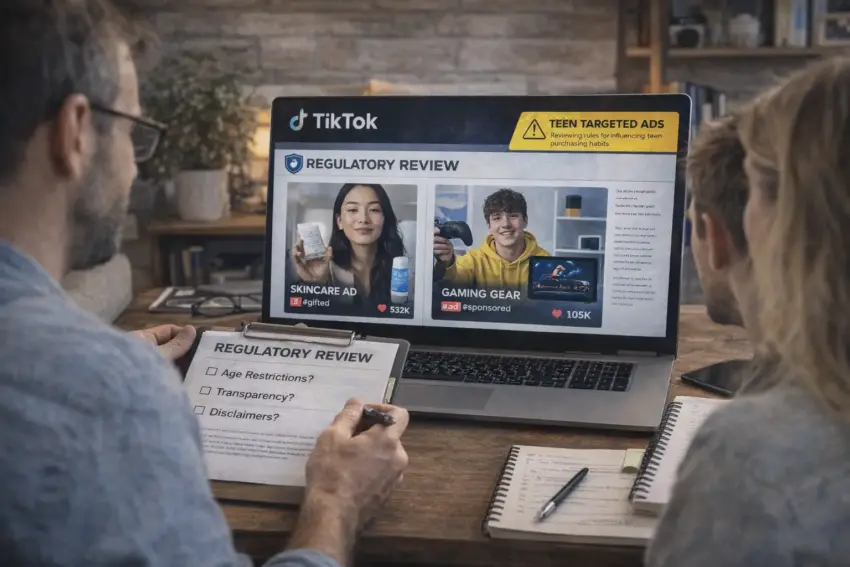
Regulators are reviewing how influencer advertising reaches teenage audiences, as concerns grow that paid promotions on social platforms can bypass age safeguards and blur the line between entertainment and marketing. The review focuses on clearer disclosures, tighter rules for targeting and placement, and stronger accountability for brands and agencies that use creators to sell products to under-18s.
The renewed scrutiny comes amid evidence that teens are frequently exposed to promotions for sensitive or harmful products through influencers and creator-style accounts, including content tied to appearance, health, and risky behaviors. Regulators and child-safety advocates argue that existing ad rules were not designed for fast-moving, personalized feeds where ads can look like ordinary posts.
What regulators are trying to fix
Policy discussions increasingly focus on three problem areas: whether teens can reliably recognize sponsored content, how platforms and advertisers define and enforce “targeting,” and how quickly misleading or inappropriate influencer ads are removed once reported. EU policy briefings have also pointed to gaps in enforcement and uneven rules across Member States, which can make cross-border campaigns harder to police.
Likely changes under review
While proposals differ by jurisdiction, the direction of travel is similar: make influencer advertising easier to identify and harder to deliver to minors for restricted categories.
- Stricter, standardized disclosure for paid partnerships (clear “ad” labeling that stays visible on mobile and in reposts).
- Tighter placement and audience rules for age-restricted products, with clearer thresholds for when content is considered “directed at” minors.
- More responsibility for brands to ensure creators comply, rather than treating disclosure failures as an influencer-only issue.
- Better platform transparency about how teen audiences are protected, including what targeting signals are allowed or blocked.
- Faster takedown and correction loops for misleading health, finance, or appearance-related claims aimed at young users.
In the UK, for example, advertising guidance includes rules that restrict directing ads for certain products at children based on media selection and audience composition, illustrating the type of targeting logic regulators want applied consistently online.
Why influencer ads are harder to regulate than traditional ads
Influencer marketing often blends into personal storytelling, making sponsorship harder to spot—especially for teens. Campaigns also scale quickly through short-form video, reposts, and affiliate links, while algorithmic recommendation can amplify content to users who were not the intended audience. Regulators and consumer groups argue that these mechanics require controls that go beyond simple “add a label” rules.
Regulators are increasingly treating influencer promotions as a high-risk format for teen audiences because ads can be personalized, embedded in entertainment, and distributed at scale with limited friction.
What brands and creators may need to do
If rules tighten, brands and influencer agencies are likely to face stronger compliance expectations, including clearer contracts, mandatory disclosure templates, and category-based restrictions for teen-facing content. Creators may also see stricter requirements to separate editorial content from advertising and to avoid promotional formats that resemble advice—particularly for health and appearance-related products.
What happens next
Regulators are expected to continue consultations and enforcement coordination, with attention on consistent definitions, workable platform obligations, and penalties that deter repeat violations. For platforms, the key test will be whether teen protections can be demonstrated in practice—not only through policies, but through measurable reductions in harmful exposure and quicker action on non-compliant influencer campaigns.