
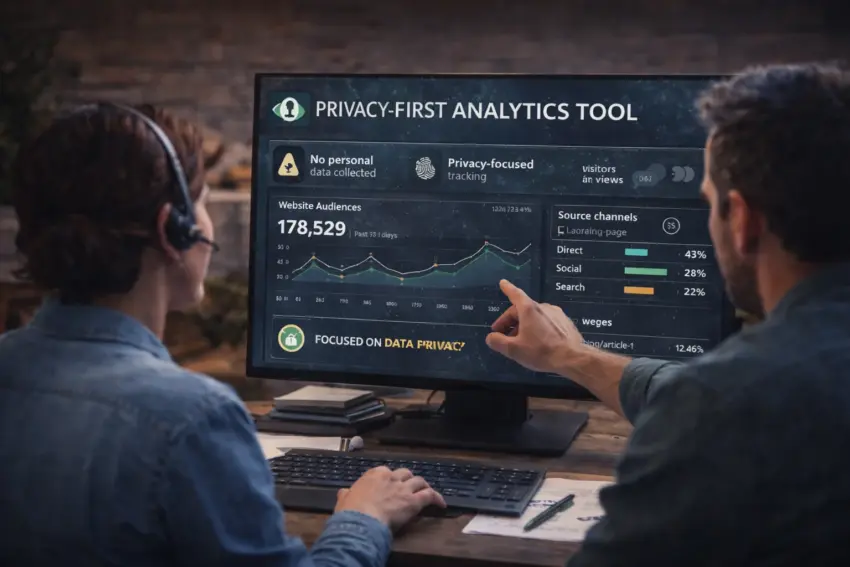
Startups across Europe are reporting growing demand for privacy-first analytics tools, as companies look for ways to measure performance without relying on tracking-heavy methods. Founders say the shift is being driven by stricter privacy expectations, uneven consent rates, and the practical need for stable metrics as browsers and platforms limit cross-site identifiers.
What “privacy-first analytics” means
Privacy-first analytics focuses on collecting only what is necessary to understand product and marketing performance, while reducing or avoiding user-level profiling. Instead of building detailed histories, these systems emphasize first-party measurement, aggregation, and shorter retention—aiming to lower legal and reputational risk without leaving teams blind.
- Minimal identifiers with limited or no third-party cookies.
- Aggregation that produces insights from grouped data rather than individual journeys.
- Consent-aware measurement that adapts when users opt out.
- Shorter retention and clearer deletion controls.
- Reduced fingerprinting exposure by limiting device signal collection.
Why demand is rising now
Traditional analytics stacks were built for an era of abundant tracking signals. Today, organizations face a different reality: privacy regulation is more visible, cookie restrictions are broader, and users are more aware of data collection. Many companies also report that marketing attribution has become less dependable, making them more willing to adopt measurement approaches that prioritize robustness over granularity.
Startups also point to procurement pressure. Larger customers increasingly require detailed answers on data processing, hosting location, and compliance—turning privacy-first design into a purchasing requirement rather than a nice-to-have feature.
Who is buying: beyond tech
While digital-native companies were early adopters, demand is expanding into sectors with stricter trust expectations or sensitive contexts. These buyers often want usable insights without creating the impression of surveillance.
- E-commerce and retail teams seeking stable conversion insights with lower consent friction.
- Publishers balancing audience measurement with reader privacy expectations.
- Healthcare and wellness services avoiding risky tracking in sensitive contexts.
- Education and public sector environments with strong compliance requirements.
- B2B SaaS firms focused on product analytics while minimizing personal data.
How privacy-first tools are built
Vendors compete on how they preserve measurement value while reducing personal data exposure. Many products rely on first-party event collection and limit what is stored or exported. Some also add privacy-preserving methods such as anonymization, aggregation thresholds, or noise to reduce re-identification risk.
- First-party event tracking collected directly by the site or app owner.
- Edge or server-side processing that filters data before storage.
- EU-based hosting options and clearer processor/sub-processor disclosures.
- Built-in governance including retention controls and access logging.
- Export limits that prevent rebuilding individual profiles outside the tool.
Trade-offs: less granularity, more resilience
Privacy-first analytics often provides fewer user-level details than legacy tools. Teams may lose certain cross-site attribution views, but gain metrics that remain usable across browsers, devices, and consent states. Many companies shift toward a combination of first-party funnels, cohort trends, and controlled experiments rather than relying on precise individual tracking paths.
What to watch next
The next phase is likely to focus on standardization and trust: clearer definitions of what “privacy-first” means, better auditability of vendor claims, and deeper integrations that do not recreate tracking risks. Startups will also need to prove that their tools can meet enterprise expectations on performance, reporting depth, and reliability—while staying compliant in a fast-evolving policy landscape.
Bottom line
Demand for privacy-first analytics tools is growing because companies still need measurement, but tracking-heavy approaches are becoming harder to justify and less reliable. Startups offering minimal-data, first-party analytics are positioning themselves as a practical alternative—so long as they can deliver decision-ready insights without sacrificing privacy credibility.